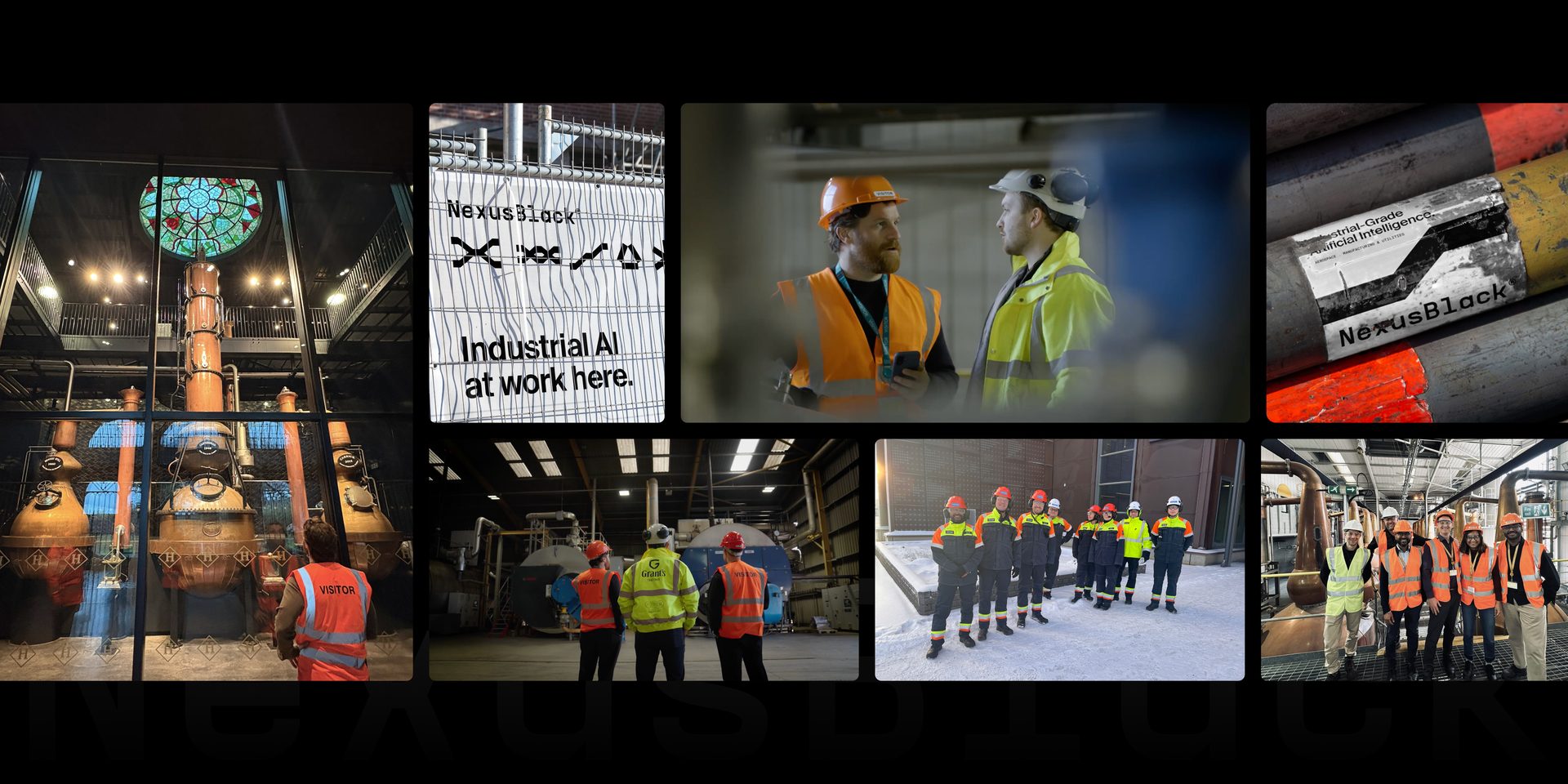
This is a product in production. William Grant & Sons. £8.4M estimated annual savings. Not a proof of concept.
We ship in weeks, not months. 4–12 weeks to value vs. 12–24 months for traditional enterprise software.
We go deep. We read P&IDs, diagnose faults from voice and video, and find savings hidden in engineering drawings. This isn't surface-level AI.
What's Different
"We were very keen to avoid the whole proof of concept trap. We said, do something at scale. And that's what we've been able to do with Nexus Black. The pace at which we've gone from idea to something real has been fantastic."
Badri Narasimhan, CTO, William Grant & Sons
"You should never lose a deal because of a product gap. If there's a wider market opportunity, we'll build it — and we'll build it fast. Days and weeks, not quarters. That's the whole point of how this team is set up."
Kriti Sharma, CEO, Nexus Black
Products, not custom solutions
Every capability is a product, not a one-off. But the products are built with customers. The team embeds on-site, shadows workers, shapes the product to hit the mark on first delivery.
12–24 mo
Traditional time to value
4–12 wks
Nexus Black time to value
Resolve
AI field service and maintenance. In production with William Grant & Sons. Active pilots with Eight Group, Ecolab, BGIS.
£8.4M
Estimated annual savings at WGS
Look at what it actually does
An engineer speaks into the app: "Look into the pressure drop we're seeing across the heat exchanger after about 10 minutes of runtime, it recovers briefly before dropping again." Here's what happens next:
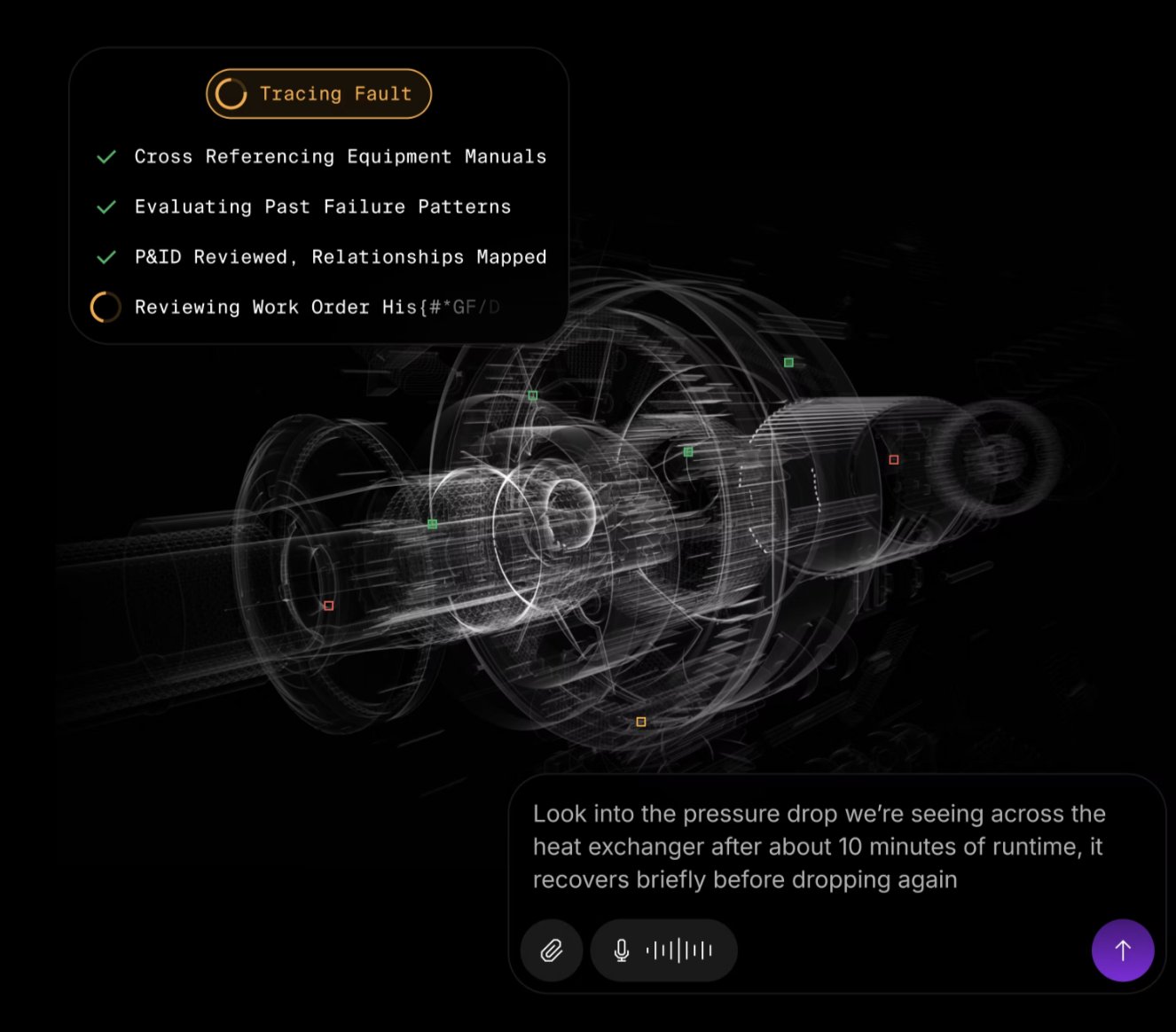
The system cross-references equipment manuals, evaluates past failure patterns, reviews the P&ID for that section of the plant, maps every connected relationship, and starts reviewing work order history. The engineer gets a diagnosis with evidence — not a chatbot guess. All while wearing gloves, not typing.
"I wanted to test Resolve on a leak we'd already raised a fault for. It came back with the same diagnosis I'd made from just two images."
Operator, Girvan Distillery — second-generation employee, William Grant & Sons
How deep does Resolve go? Here's an example.
We taught it to read the most important document in process manufacturing.
Every process manufacturer has P&IDs — Piping and Instrumentation Diagrams — that map every pipe, valve, sensor, pump, and safety device. It's the single drawing that tells you how the whole process works. Most engineers need years to read one fluently. The retiring ones take that knowledge with them.
Resolve reads them — with reasoning, not template matching. Multiple AI models cross-check every extraction: one reads, a different one challenges, and the first corrects. By the time it's done, it has the full picture.
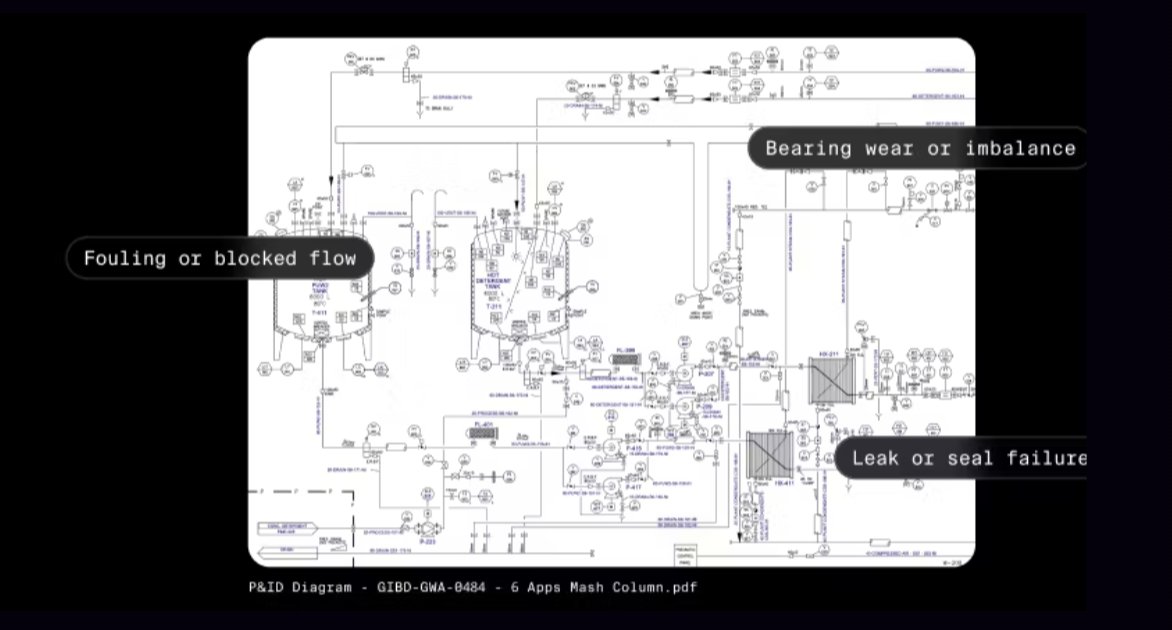
WGS Mash Column P&ID — GIBD-GWA-0484. Resolve identified bearing wear, fouling, and seal failure risks automatically.
When it's not sure, it leans in closer.
If a tag is ambiguous — does TT-014 connect to pump P-26 or P-28? — the system zooms in, crops that area, and runs a separate AI agent to verify. The same instinct a veteran engineer has with a magnifying glass, except it never gets tired.
It doesn't just read the drawing: it thinks about what could break.
For every asset, Resolve maps connections, likely failure modes, and detection methods. Problem with pump P-26? Instant answer — 3 connected instruments, feeds into heat exchanger HX-04, most likely failure is bearing degradation, detectable via vibration sensor VT-014. Pre-computed. No waiting.
It catches things the humans missed.
Pressure relief valves flagged with testing requirements. Emergency shutdown paths traced end to end. Real numbers, not summaries. And yes: it has found genuine errors on existing P&IDs that passed manual engineering review.
Proof point: We pointed Resolve at a WGS distillation column P&ID. It identified every safety-critical element — pressure relief valves, emergency protection systems, overpressure setpoints. It found cascade loops that tighten quality variation by 50–70%, and traced an energy recovery system worth £1–2M per year in savings. All from one drawing. Minutes, not weeks.